Yearly Archives: 2021

Final thoughts about our Lakes tour


We were never far from a body of water on this trip. I read that no point in Michigan, where we spent close to half of our time, is more than 6 miles from an inland lake or more than 85 miles from a Great Lake.

We saw big lakes, small lakes, ponds and bays, rivers and streams and creeks. Sometimes we saw water that was placid and still; sometimes the water created waves. Some waves were gentle, some waves were breaking on rocky shores. And we saw several water falls, from the mighty Niagara to the 90-foot high, narrow Aunt Sarah’s Falls in Watkins Glen. We saw mostly naturally formed bodies of water, but we also saw human made canals.

Seventy percent of the earth’s surface is water. Seventy percent of the human body is made of water. Interesting coincidence? Maybe that’s why humans are drawn to water. Or maybe it’s because water is so elemental. There’s research that finds that people who live on the coast are happier than those who live inland. The term “Blue Mind” was coined by marine biologist Wallace Nichols to refer to the meditative state we experience when we’re by the water. He wrote a book about it.

We saw and experienced some beautiful sights on this trip. I’ve heard some people exclaim that the US is “such a beautiful country”. It is, but there are lots of other beautiful places in the world. Some I’ve seen myself like Iceland, the Azores, the Bay of Fundy; some I’ve read about or seen in pictures or movies. I watched all three seasons of “Hinterland”, a not very good detective show filmed in Wales, because the scenery was so breathtaking.

The entire planet is beautiful and awe-inspiring and an incredible gift. If only humans could stop spoiling it.

Heading Home

In Rhinebeck

All good things must come to an end, eventually. This ‘Lakes Tour’ has been a joy. We got to see all five of the Great Lakes, the Finger Lakes in New York as well as many smaller lakes. We will have traveled for nine weeks from the heat of summer into the chilly fall. (It was 39 degrees last night. Brrr.) We traveled to six states and have memories and stories that will be with us for a long time.

All the states we have visited in our RV

For our last two nights on the road, we came to Rhinebeck, NY, in the Hudson Valley. We have stayed at this campground before. It’s in a rustic setting and is laid out nicely. It’s not too close to other campers and the hilly terrain makes it a pretty campground. We chose this campground because it’s not too long a drive back to Rhode Island. Today we cleaned the RV and packed up the things we will be taking home. We took some time in the afternoon for a drive around the area.

First we went into the village of Rhinebeck. It’s a cute town with many eating establishments, a sure indication that they cater to tourists. We took a drive south and happened upon a state park that borders the Hudson. It was one of those serendipity events that has happened several times on this trip.

Margaret Lewis Norrie State Park

The land for the Margaret Lewis Norrie State Park was donated to the state by Geraldine Morgan Thompson, in memory of her sister. Geraldine (1872 – 1967) was a feminist social worker who worked on female prison reform, public health and juvenile justice. She was a long-term friend of Eleanor Roosevelt. She had a 40 year romantic relationship with Miriam Van Waters, a prison reformer who served as superintendent of the Massachusetts Reformatory for Women at Framingham. We drove thru the park to a small area by the Hudson River. It was late afternoon and the sun was shining brightly over the river. I imagined how it must have been hundreds of years ago, before European settlers came to this area. Paddling down the river to where it meets the Atlantic must have been so beautiful.

Nathanael Greene

Nathanael Greene Statue

As a Rhode Islander, it would be improper for me to skip over our last day in ‘the District’. We met Tessa for a final hello and lunch. We decided to have lunch outdoors at Stanton Park, because of the Nathanael Greene Statue there. If you don’t know, Greene, a native of Warwick, RI, was a general in the Revolutionary War and was well respected, considered Washington’s most talented and dependable officer. During the war, Greene used his funds to pay for clothing and supplies for his troops. After the war, the debt became due, which resulted in Greene being in debt when he died in 1786. I had known about Greene since both of our children went to the middle school named after him. Hats off to Nathanael Greene for his significant efforts and hardships to help win the Revolutionary War.

Audiobooks for the Road

We’ve started listening to audiobooks on our long drives between campgrounds. I’m not sure why it took us until this trip to think of using the driving time to listen to books, maybe because neither of us are regular consumers of “books on tape” (such an old-fashioned word). But here we are and here are this trip’s books.

1. “Project Hail Mary” by Andy Weir (Weir wrote “The Martian”, adapted into a movie with Matt Damon.) Narrated by Ray Porter

The book is set in the near future. The sun is dying. Scientists predict it will lead to an ice age that will make the earth uninhabitable in 30 years. International divisions are set aside as a global effort is mounted to understand what’s happening and to find a solution. The protagonist, Ryland Grace, a former microbiologist turned middle school science teacher, is tapped to join the research team, based on his past research. Grace discovers alien microbes are feeding on the sun’s energy. He names them astrophage, Greek for ‘star eater’. When astronomers discover a sun-like star that’s unaffected by astrophage, the team sets out to design and build a spaceship to travel to the star to learn why. And Project Hail Mary is born.

Three scientists will crew the ship to search for the answer and send the data back to earth. It will take several years to reach the star so it’s decided that the crew will be placed in comas. Grace is forced against his will to join the crew when a deadly lab explosion results in a need for a new science officer. He’s not interested in joining the suicide mission, but he’s the only other qualified scientist with the coma resistant gene that minimizes the risks of prolonged coma.

The book opens with Grace waking up on the ship, the two other crew members are dead and he has amnesia. His memory gradually returns as he pieces together the puzzle of where he is and why. He encounters an alien ship heading for the same star. He makes contact and discovers another stranded traveler also on a mission to save its dying planet from the affects of astrophage.

The alien is a five-legged spider-like creature that communicates in musical tones who Grace calls Rocky. He sets out to understand Rocky’s language by developing a computer program to translate the tones into English. Eventually the two of them are able to communicate with each other.

The heart of the book is the relationship that develops between Grace and Rocky as they work together to save their respective planets. It’s a heartwarming story of reaching across differences and forming a relationship of trust, loyalty and genuine affection.

There’s lots of science in the book. And some readers may find it too technical. But it was written well enough that it was easy to read (in our case, hear). And the story was suspenseful enough to keep us interested.

2. “The City Born Great”, a short story by N.K. Jemison, Narrated by Landon Woodson

Michael found this selection through OverDrive at our public library.    N. K. Jemison is a science fiction and fantasy writer. She was the first author to win the Hugo Award – the Oscars of the science fiction/fantasy world – three years in a row. I’ve read the first 2 books in Jemison’s “The Inheritance Trilogy”: “The Hundred Thousand Kingdoms” and “The Broken Kingdoms”, and liked them both very much, especially the first one.

“The City Born Great” is dubbed an urban fantasy. (Jemison later expanded the story into a novel titled, “The City We Became”) The premise of the story is that some cities develop character and soul and must be midwifed into a living, breathing organism by someone who will be its protector from evil forces out to destroy it.

The story is so fantastical, and along with my limited imagination, I sometimes had trouble following it. It’s about the birth of NYC and its protector, a young black man who is homeless and living on the streets of NYC. He can hear the faint music of the city. He’s a reluctant protector, especially when he encounters the evil destroyer in the form of 2 shape shifting police officers. It’s such an inventive story and I really like Jemison’s writing, even if I don’t always “get it”. I liked it enough that I plan to give it another read. Maybe it’ll make a little more sense the second time around. Or maybe I’ll just move onto the third book in the “Inheritance Trilogy”.

3. “Lafayette in The Somewhat United States” by Sarah Vowell, Narrated by Sarah Vowell, John Slattery, Nick Offerman, Fred Armisen, Bobby Cannavale, John Hodgman, Stephanie March, Alexis Denisof

Sarah Vowell has written several nonfiction books on American history and culture. She’s not an historian, she self-identifies as historian-adjacent. When a subject catches her attention, she takes a deep dive into learning all she can about it. She then writes not only about the subject, but about her research travels and the culture of the time. Her books are part history, part travelogue, part social commentary wrapped up in wisecracking humor. I like her sense of humor. She’s also done some acting and is the voice of Violet in Pixar’s “The Incredibles”.

Her seventh book is about Marie-Joseph Paul Yves Roch Gilbert du Motier, Marquis de La Fayette, well known to Revolutionary War history buffs and well-loved by “Hamilton: The Musical” fans. He’s typically referred to by his title, Marquis de Lafayette or simply, Lafayette.

Lafayette, a member of the French aristocracy, came from a long line of military officers. His father died in battle; his mother died when he was 12 years old leaving him all of the family’s lands and money. He had an adventurer’s soul and a hunger for glory. He found the American colonies’ fight for independence a noble cause and at 19 snuck out of France, against his father-in-law’s strong objections, to sail to America and offer his services to the Colonial Army. He became a trusted member of George Washington’s advisors. Washington considered him the son he never had. And the significance of France’s help in winning the war can’t be overstated; without it we’d probably be British citizens.

In 1824 at the invitation of President Monroe, Lafayette – the last surviving French general of the America Revolution – spent over a year making a grand tour of the 24 US states. He was treated like a rock star everywhere he went. 80,000 people (65% of the city’s population) greeted him when he disembarked in New York Harbor. Some say he was America’s first celebrity. It’s hard to find an American town that doesn’t have a street, a square, a park, a county, a monument named for Lafayette. And there’s Lafayette College, Lafayette River, Lafayette, Louisiana, California, Georgia and the list goes on. My first office was on Lafayette Street in Pawtucket.

In Sarah Vowell fashion, she starts with Lafayette, then meanders into an in depth telling of the Revolutionary War and weaves in her own social commentary. I really like her books, although they’re not everybody’s cup of tea. Michael, the history buff, had mixed feelings about the book. He likes his history a bit more straightforward. I like my history delivered with humor and Vowell’s quirky sensibility.

4. “Here and Then and Now” by Mike Chen, Narrated by Cary Hite

Here’s the premise. It’s 2149 and time travel has been perfected. Given the flaws of human nature some nefarious individuals travel back in time to exploit historical knowledge for financial gain – think someone who knows the winning number of the biggest lottery payout going back to play that number and collect the prize (maybe even offing the original winner). Temporal criminals. The Temporal Corruption Bureau (TCB) is established to travel back and apprehend these criminals and minimize temporal disruptions.

Kin Stewart is a TCB secret agent. He finds himself stuck in 1996 when the mission he’s on goes awry and the technology he needs to return is damaged. He waits to be retrieved by the TCB. Days turn into weeks, weeks into months, months into years and no one comes. Eventually accepting that he may never return to his own time – and gradually losing memory of his real life without the “metabolizers” that counteract the effects of time travel on bodily and cognitive functioning – he creates a life for himself. He takes a job in cyber security, falls in love and marries, has a daughter and is living happily in San Francisco when the TCB are finally able to track his whereabouts and an agent is sent to retrieve him.

The problem is 18 years have passed for him, but it’s only been 2 weeks in 2149 since he went missing. Kin doesn’t want to leave his wife or now 14-year-old daughter, but he has no choice. His life in what’s referred to as 21A (early 21st century) has already broken protocol and created temporal distortions. He’s sent back against his will.

Back in 2149 he has a fiancée, who doesn’t know the true nature of his job. They were planning a wedding and a life together before the mission. He has difficulty settling back into 2149 pulled by his attachment to his wife and daughter and haunted by how his sudden, unexplained disappearance affected them. Against TCB rules, he accesses the Bureau’s archives to learn their fate. And what he learns only adds to his guilt and intensifies his need to be a father across time.

It’s an interesting story, less science fiction and more about family relationships. Most parents can identify with the intensity of emotions you feel when your kid is in trouble and there’s little you can do to help. We found some plot holes that seemed obvious to us. But the story of a father’s love and commitment and willingness to sacrifice all to help his daughter overshadows the minor plot problems – at least for me.

We have just a few chapters left, enough to get us home. But I’m already glad we stumbled upon the book. And I’ll be looking out for more books from Mike Chen.

The Attack of the Black Walnuts

Some of the culprits

We safely arrived in Downingtown, PA, near Philly. It’s a rustic campground on a rural road that we have stayed at previously. The campground is next to the East Branch Brandywine Creek that flows along lazily.

After backing into the site and hooking up, we heard a loud bang coming from our roof. Then several more. It turns out that we are parked under a Black Walnut tree. And they are raining down. Imagine sitting quietly in your RV and then hearing a loud crack! That’s what we have been experiencing.

Our campsite, with the Black Walnut trees above us

Other than the walnut experience, we think a cricket has decided to come visit us. We heard a cricket that sounded like it was inside the RV. I tried looking for it and couldn’t discover where it is resting. Fortunately, it only chirped for a short period last night.

The weather is warm here. We plan a bike ride this afternoon. Tomorrow and Sunday we are visiting some friends.

Family time

We’re spending this week at Cherry Hill Park in College Park, MD. It’s our third time here. It’s our go-to campground when we come to greater DC. The big draw, of course, is Tessa who is living and working in the District, and her partner Dan. Michael’s sister lives in nearby Rockville. Michael has cousins who live in Columbia, MD. And the most recent addition to the Greater DC family group is Michael’s nephew and young family who moved to suburban Baltimore in June. Our time here is not about exploring or touring or sightseeing, it’s about family time.

We did take a really nice bike ride before meeting up with Tessa. We can get on the Paint Branch Trail from the campground. You have to bike over I-495 to get to the trail head. And biking on a narrow, open-grate bridge over eight lanes of speeding traffic is a little nerve-wracking. But it’s worth it. Within a couple of minutes you’re on a pretty, wooded trail that occasionally crosses over the Paint Branch stream.

We spent Friday evening at Tessa and Dan’s apartment. We caught up on their lives over takeout, then slid into telling – sometimes retelling – family stories of when the kids were young. I love it! There’s usually lots of laughter. I think Dan enjoys it, too.

We got to spend all day Saturday with Tessa (Dan left for a long weekend with family). The one touristy thing we did do was visit the Smithsonian Museum of American Indian. We preferred focusing on the beauty and wisdom of the Indigenous peoples of North America and skip over the history of mostly reprehensible interactions between Europeans and the Native populations they encountered.

So, we went up to the fourth floor and spent time in the exhibit called “Our Universe: Traditional Knowledge Shapes Our World. The exhibit explores the world view of eight tribes, their philosophies, the values they live by and pass on, their relationship with the natural world and the wisdom of long-ago ancestors. I loved the Anishinaabe Gifts of the Seven Grandfathers:  Honesty, Love, Courage, Truth, Wisdom, Humility, Respect and their teachings on using these gifts.

On Sunday, we spent time with Michael’s nephew and his family. It’s nice to see Michael’s nephew and his wife whom we very much love, but it’s the little ones who get most of our attention – a firecracker of a 3 1/2 year old with boundless energy and a sweet, easy going almost one year old. They’re so much fun.

Monday we had our final visit with Tessa, it’s always tough to say goodbye. And in the evening we had dinner with Michael’s sister and her husband. It’s always nice to see them. Today is a work day for Michael and a puttering day for me. Tomorrow we have a couple more family visits, then we head to Philadelphia as we close in on home.

Bella Terra Vineyards

On Wednesday (10/6), we spent the night at Bella Terra Vineyards – a Harvest Host – in Western PA. It’s on 14 acres of land, including a lake; a very rustic setting and close to the Pennsylvania Turnpike.They have a bright, airy winery and a large outdoor patio and a bistro. They’re an event venue and a beautiful location for an outdoor wedding.

Wednesday night is open mic night. After dinner we stayed for the music. Several musicians performed, some more polished and entertaining than others. Most seemed to be hopeful musicians taking advantage of a local stage to play out their dreams of performing.

In the morning as we were packing up to leave, a flock of what I at first thought were turkey hens came pecking around the RV. When I got a closer look I realized they were too attractive to be turkeys. A quick check with my bird identifying app and I learned they were guinea fowl.

Apparently, guinea fowl have become popular on small farms. They provide good pest control by eating ticks, beetles and other insects. They also eat mice and even snakes. And they’re good “watchdogs” by shrieking loudly when something unusual enters their area. Some farmers consider them a good addition to their barnyard.

Zanesville, OH

After leaving Indianapolis we made a pit stop in Zanesville, Ohio, a city of 26,000, 55 miles east of Columbus. It sits at the confluence of the Muskingum and Licking Rivers, tributaries of the Ohio. It’s referred to as Y-City, for its Y-shaped bridge. Built in 1814, the bridge was a creative solution for how to get across 2 rivers. It’s one of 8 Y-bridges in the world, including Ponte de Três Entradas in Portugal, the Bridge of Three Entrances.

We’re here for only 2 nights so that Michael could have a full day to work. The weather was sunny and in the 70s, a perfect day to relax outside, reading my book. The only negative was the stink bugs that swarm around. They are not shy.

At the end of Michael’s work day we drove into town for dinner. We ate at Muddy Misers Restaurant along the Muskingum River. I had a very tasty Craw Tail Po’Boy Sandwich with Cajun Cole Slaw and a cup of Carolina Clam Chowder. So yummy. I asked the server what made ‘Carolina’ chowder. She said it’s ‘white’. Sounds like regular New England clam chowder. But this one had way more clams and I think some white fish thrown in.

After dinner we took a short drive through downtown. It seemed like an artsy city, with lots of outdoor art. Main Street was decorated for Halloween with interesting scarecrows tied to lampposts, up and down the street. I later read that Zanesville has a growing colony of artists. It shows. I regretted not having time to explore the area.

The view from our table

Indianapolis

The forecast predicted rain for the entire weekend, but the rain held off for today. Although overcast it was a mild, pleasant day. We ventured into Indianapolis to get a sense of the city. As we drove through downtown, a beautiful old building caught our eye. Turns out it was the Kurt Vonnegut Museum and Library. Vonnegut was born and raised in Indianapolis. We had to check it out.

“Slaughterhouse-Five” was a must read when I was in high school. It was the perfect book for the Vietnam War era – an absurdist, anti-war book. It was so different than anything I had ever read. I read several of Vonnegut’s books and loved his book of short stories, “Welcome to the Monkey House” (my copy was falling apart, so I bought the latest edition in the museum store). I didn’t always understand his books, but was still drawn to them.

Vonnegut was a student at Cornell in the early 40s. He left school in 1943 to enlist in the Army; he was twenty-two. The top floor of the museum was about Vonnegut’s experience in WW2. Three large panels describe the relevant facts about the war and his experience as a POW. Vonnegut and 50 other American soldiers were captured during the Battle of the Bulge. They were forced to walk 400 miles through the snow to a POW camp in Dresden. His experience in the War influenced his writing.

Vonnegut was a staunch supporter of freedom of expression. The museum has a display of books that have been banned in the US. In 1973, a school board in North Dakota banned “Slaughterhouse-Five” from being read in their high school. A copy of the letter Vonnegut wrote to the Chairman of the Board was also on display. https://www.huffpost.com/entry/kurt-vonnegut-letter-to-drake-high-school_n_1392557

Banned books display

After our museum visit we took a walk along the Indianapolis Canal Walk. The walk is a 3 mile long pedestrian loop that follows the path of the old Indiana Central Canal which was dug in the early 1800s. In the 1980s a section of the old canal was restored and the Canal Walk is now a popular downtown attraction.

Indianapolis Canal Walk

Photo Gallery – Great Lakes

Grafitti in Cheboygan, at the Straits of Mackinac
campground art, Lake Huron
Selfie at the Tahquemenon Falls State Park
Michael on his Dune Climb
Waterfowl

Heading South

Camping at the farm

Sadly, we have left the Great Lakes. It was a great experience touring this area. The last two spots, Traverse City and Mackinaw City were wonderful. I’d like to come back again sometime.

On Thursday we drove to southern Michigan farm country. We actually stayed at a farm, courtesy of Harvest Hosts. It was a lovely stay. Nicole, our host, told us about the farm and the animals. We went to their garden and she picked some vegetables for us—carrots, tomatoes, peppers, Swiss chard, kale and bok choy. We chopped and cooked it all for dinner, very yummy. The carrots were so good, we ate them raw.

On Friday we drove down to Indianapolis. I had planned on seeing an old friend who lives here but found out yesterday that his wife tested positive for COVID, even though both of them were vaccinated. They are quarantining, so we won’t be able to see them. Thank you, pandemic and all the people who refuse to get the vaccine.

Today it’s raining. We are doing laundry and probably will do some errands at some point. It’s a catch-up day.

Dark Sky

Sunset at Headlands International Dark Sky Park

We left northern Lower Michigan this morning. We’re spending the night at a Harvest Host, Frontière Farm House, in Marshall, 13 miles east of the home of the Kellogg Company, Battle Creek. Tomorrow we head to Indianapolis to visit an old friend of Michael’s. I’m sad to leave the Great Lakes behind.

We spent last night star gazing at the Headlands International Dark Sky Park in Mackinaw City. The Headlands Park has 550 acres of woodlands on more than two miles of undeveloped Lake Michigan shoreline. In 2011, the Headlands became one of the first International Dark Sky Parks in the world. In 2007, Natural Bridges National Monument in Utah became the first designated Dark Sky Park; Today, there are over 180 in the world.

I had never heard of a Dark Sky Park. So, what is it? It’s a park or other public land with exceptional starry skies, where natural darkness is valued as a natural resource. To get the designation, a park has to be accepted and certified by the International Dark Sky Association (IDSA) after a rigorous application process. Founded in 2001, the goal of the IDSA is to encourage communities to preserve and protect the night sky. It’s the leading organization combating light pollution worldwide.

From the Park’s entrance you drive down a dark, wooded, winding road to the parking lot. The road is narrow and you have to maneuver a little to allow an oncoming car to get by. From the parking lot there’s a long path lit by red lights leading to the observation area at the shoreline. The area is laid out in front of the Waterfront Event Center. The Center has several rows of long steps facing the lake. The steps form a kind of stadium seating. Many of the folks there were sitting on the steps.

At the head of the path is a list of rules: No flashlights, no cell phone use, no flash photography – white light pollutes the sky. And no laser pointers. Of course, not everybody respected the rules; so annoying.

We got to the Headlands at about 8pm dressed for the weather with a couple of lap quilts (made by me) for extra warmth. It was a mild, calm night, but the temperature at the lake is about 10 degrees colder than the inland temp. There was not a cloud in the sky. The sun had set, but the horizon was still glowing with the sun’s final rays. The sky was starless. We set up our chairs and along with about 60 other folks, waited.

And then the stars gradually made their appearance. A couple of folks had fancy looking cameras set up on tripods – clearly they were very serious about their star gazing. As an especially bright “star” made its appearance someone in the crowd declared that it was the International Space Station. Other folks were pointing out constellations. We saw a couple of shooting stars. I wish I had studied up on the night sky, but the only thing I recognized was the Big Dipper and the Milky Way. The sky was blanketed with stars by the time we left.

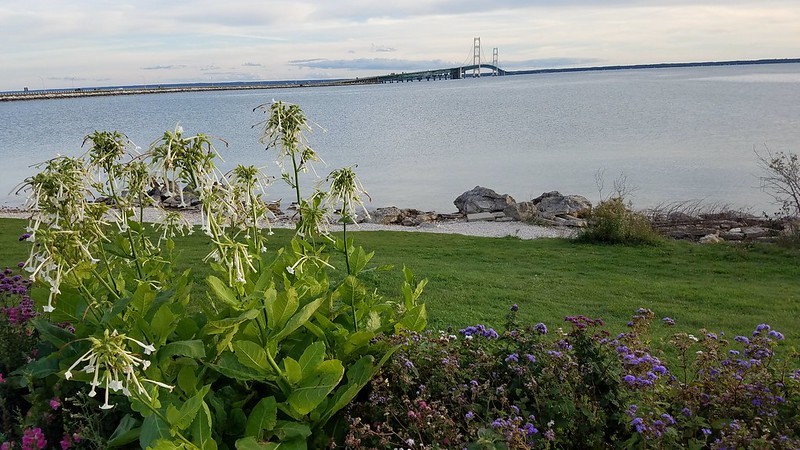
This morning before heading out, I took a final walk to the shore behind the RV to say goodbye to Lake Huron, the Mackinac Bridge and our Great Lakes tour.

The bench behind our campsite. My place to sit and take in Lake Huron
A final look at the Mackinac Bridge in the distance.

i thank You God for most this amazing day

Lake Huron at Sunrise

We’re sitting by the Lake Huron shoreline on a cool but sunny fall afternoon. The Mackinaw Bridge is in the distance; we watch as the cars and trucks seem to crawl over it. The small waves lap the shore. It is soooo peaceful here. It’s a blessing to be here today.

This morning we took a ride down to Cheboygan, a small coastal town a few miles from here. After lunch at a park overlooking the bay, we did a quick shopping run. We got back to the RV, put the groceries away and wondered what to do next. Both of us decided to just stay here at the campground, enjoying the moment.

This is our last day here and our last day visiting the Great Lakes. Tomorrow we head toward Indianapolis. We will miss this beautiful place.

Sunrise over Lake Huron

Lake Superior

Monday was the big day – we met our fifth Great Lake, Lake Superior. Lake Superior is the northern border of the UP. It is the largest and northernmost Great Lake. It holds 10% of the world’s fresh water supply. (The Great Lakes in total hold 18-20%). Most of it lies in Canada. It’s Canada’s largest lake.

Getting to Lake Superior from Mackinaw City requires driving over the Mackinac Bridge, across the eastern part of the UP to Whitefish Bay. As you drive over the bridge you get a clear view of both sides of the water – Lake Michigan to the left and Lake Huron to the right. Someone we know who is native to Michigan suggested one of us drives one way and the other drives back. It was a great suggestion; it allowed each of us to fully take in the Lakes. I drove on the way up.

When you get to the Upper Peninsula you quickly notice how different the landscape is from lower Michigan. Lots of trees with no farmland. We stopped in the village of Trout Lake at what looked like a convenience store, an IGA grocery store as it turns out, for a bathroom break. I tried to engage the store clerk (an older woman, maybe the owner) in conversation as I paid for my Coke, but I didn’t get much from her. I figured she was just a taciturn sort, until a man came in, clearly a local, and she greeted him warmly. Maybe it was my face mask, maybe being an outsider, either way she was not interested in talking with me. Very different experience from my interactions with other Michiganians, who have all been cheerful, warm and helpful.

Outside the IGA. You won’t find this outside most grocery stores.

It was about a little over an hour’s drive to get across the UP to White Fish Bay at the eastern end of Lake Superior. There you find The Great Lakes Shipwreck Museum, located at the Whitefish Point Light-Station.

We made it! Lake Superior.

The Michigan Shipwreck Research Association estimates there are more than 6,000 shipwrecks at the bottom of the Great Lakes since the late 1600s when commercial sailing ships began crossing the Lakes. Unpredictable weather with fierce and sudden storms and lots of fog made for dangerous crossings.

The SS Edmund Fitzgerald is the largest ship sunk in the Great Lakes. It carried iron ore from Minnesota to several Great Lake ports. It was considered a “workhorse”, setting record hauls, 6 trips in one season. The ship was lost on November 10, 1975, with 29 crew members on board. That last thing heard from it was the captain reporting, “We are holding our own.” No distress signal was sent.

A memorial to the Edmund Fitzgerald sits at the top of the beach at Whitefish Bay. The shipwreck is memorialized in the song by Gordon Lightfoot, “The Wreck of the Edmund Fitzgerald”

“The legend lives on from the Chippewa on down
Of the big lake they called Gitche Gumee
The lake, it is said, never gives up her dead
When the skies of November turn gloomy.

And later that night when his lights went outta sight
Came the wreck of the Edmund Fitzgerald.”

Next stop was Tahquemenon (rhymes with phenomenon) Falls State Park. The Falls are one the largest waterfalls east of the Mississippi. The Upper and Lower falls combine for a drop of nearly 73 feet and it’s more than 200 feet across. The water is brownish in color leading some to wonder if it’s polluted. It’s not. The color comes from tannins leached from the cedar swamps along the Tahquemenon River. One of its nicknames is “the Root Beer Falls”.

You can get a good view of the Upper Falls. A nicely paved path about a quarter mile from the parking lot leads you to good vantage points. 94 steps take you down close to the Falls. Michael ventured down. I sat and admired the rushing water.

Tahquemenon Upper Falls

On our way back we stopped at several places to get a closer look at the Mackinac Bridge, both “above the bridge” (the UP side) and back in Mackinaw City. One of the parks we stopped at had a tribute to David Steinman, the designer of the Bridge. He believed bridges should be beautiful. He even wrote poems about bridges; “A bridge is a poem stretched across a river, a symphony of stone and steel”. He designed the Mount Hope Bridge spanning the Narragansett Bay from Bristol to Newport, RI.

The Mackinac region

We arrived in Mackinaw City on Sunday (9/26). We’re staying at Mackinaw Mill Creek Camping. The campground has over 200 acres of woods and a mile of Lake Huron shoreline with a view of the Straits of Mackinac and the Mackinac Bridge. It is an impressive campground, probably the biggest we’ve stayed at. As I write this, I’m sitting about 12 feet from the waters of Lake Huron, with a clear view of the Bridge. It’s 57°, breezy but sunny. I would never sit outside at this temperature back home. But with Nature’s awesomeness spread out before me, who cares about a little nippiness.

The view from the RV

I never thought much about the state of Michigan. I could have pointed it out on a map only because of its proximity to Canada. And I didn’t think of it as a state worth visiting. It’s a Midwestern state and I must confess, as a lifelong resident of the land of the coastal elites, I have an unfavorable bias towards the Midwest. Remember how last year an anti-government group called the Michigan Militia plotted to kidnap the governor, Gretchen Whitmer, and incite a civil war over Covid restrictions? Sheesh, why would I want to visit a state as crazy as that? Well, one of the benefits of travel is having your biases challenged.

When we planned this current trip our focus was the Great Lakes. Since Michigan is bordered by 4 of the 5 Great Lakes (only Lake Ontario misses Michigan) there’s no way to explore the US Great Lakes without spending time in Michigan. So we find ourselves in Michigan for close to a month. And what a breathtakingly gorgeous state it’s turned out to be. Fun Fact: No point in Michigan is more than 85 miles from any one of the Great Lakes.

Mackinaw City is at the northern tip of Michigan’s Lower Peninsula along the southern shore of the Straits of Mackinac. Time for a quick geography lesson.

A picture is worth 1000 words

The state of Michigan is made up of two peninsulas, what’s referred to as the Lower Peninsula and the Upper Peninsula. The Lower Peninsula is shaped like a mitten. It’s mostly flat and a distinctive feature is the “Thumb” jutting out into Lake Huron, creating Saginaw Bay. The Upper Peninsula is mostly forested, reaches higher elevations and has rugged terrain.

The Upper Peninsula, referred to as the U.P., shares a border with Wisconsin and a bit of Minnesota. It’s physically separated from the Lower Peninsula. The UP is about 30% of the land mass of Michigan. The peninsula is as large as Connecticut, Delaware, Massachusetts, and Rhode Island combined, but has fewer than 330,000 inhabitants, referred to as “Yoopers”.

Short waterways between the peninsulas are called the Straits of Mackinac and connect Lakes Michigan and Huron. As early as 1920, suggestions to bridge the 2 peninsulas were kicked around, ranging from building a “floating” tunnel to building various combinations of bridges and causeways. The state settled on establishing a ferry service. Then in the 1950s a major bridge was proposed. And on June 28, 1958 the Mackinac Bridge, the Mighty Mac, was formally dedicated.

The Mackinac Bridge is currently the fifth longest suspension bridge in the western hemisphere. Longer than the Golden Gate Bridge, you may ask? Yes! The Golden Gate is the oldest suspension bridge, it’s taller than the Mackinac Bridge, it’s also wider and carries more traffic. But it’s only 1.7 miles long; the Mackinac is 5 miles long. And to add to its awesomeness, the Mighty Mac straddles Lakes Huron and Michigan. The Golden Gate Bridge straddles a puny mile wide stretch of water called the Golden Gate Strait. Ok, the Golden Gate offers views of San Francisco Bay and the Pacific Ocean, but the Mackinac is still down right impressive. And it’s not shrouded in fog (or wildfire smoke).

A word about pronunciation. You may have already noticed that some things are spelled “Mackinaw”, others “Mackinac”. Regardless of spelling it’s all pronounced Mack-i-naw. The Anishinaabek people named this area Michinnimakinong, an Ojibwa word which translates as ‘“great connecting sound fault land or place”. The Anishinaabek made their home in this area. They were a group of culturally related indigenous people consisting of 7 clans, of which one was the Ojibwa. The Mackinac Island in Lake Huron was called Mitchimakinak, “the place of the great turtle”; the indigenous settlers thought the island looked like a big turtle.

The first Europeans to arrive in Michigan were the French. The French were traders and traded with the Indigenous peoples. The French translated the local language into something more fitting to their own language and recorded the place names with a “c” on the end as a French word with an “aw” sound would be pronounced. But the French lost the French and Indian War to the British and everything became anglicized.

The UP is bordered on the north by Lake Superior. The Ojibwa name for the lake was “gichi-gami”, meaning “great sea”. The French called it “le lac supérieur”. And when the British beat the French they called it Lake Superior, “on account of its being superior in magnitude to any of the lakes on that vast continent”.

Next up: our trek over the Mackinac Bridge, across the eastern part of the Upper Peninsula to Whitefish Bay and Lake Superior.

Good bye Traverse City

Tomorrow we leave Traverse City. We’ve enjoyed our stay here in this beautiful area.

Yesterday we took a bike ride on a section of the TART (Traverse Area Recreation Trail). It’s a nicely maintained bike path that follows the old railroad bed of the former Chicago and West Michigan Railway. We had parked the car at the Cherry Bend Community Park. The Park has a pavilion with several picnic tables. After our ride we found a sunny spot at one of the tables-it was a little too cool in the shade-and had our lunch. We always take a “brown bag” lunch with us.

After lunch we drove the 18 miles on M-37 to the tip of Old Mission Peninsula, the finger of land that heads north from downtown Traverse City to Grand Traverse Bay. The peninsula is about 3 miles wide. The drive takes you by cherry orchards and vineyards. Lighthouse Park is at the tip of the peninsula. The Park has a restored turn of the century log cabin (it reminded me of Little House on the Prairie), hiking trails, a pretty beach and, of course, the Old Mission Lighthouse. The lighthouse has a small museum with exhibits all about lighthouses.  Fun Fact: the Boston Light in Boston Harbor is the oldest continually used and only staffed lighthouse in the country.

On our way back we stopped at the Bonobo Winery; there are 10 wineries on the peninsula. We each got a glass of wine and sat on the big, very pretty deck overlooking the vineyard with the Bay in the distance.

Bonobo Vineyards

Today we went to the Dennos Museum on the campus of Northwestern Michigan College in Traverse City. The Museum has a permanent exhibit of the art of the Inuit of the Canadian Arctic.  It’s one of the most historically complete collections of Inuit sculptures and prints available. So much of the art was about the natural world. I’m guessing that speaks to the Indigenous peoples’ connection to nature.

The museum was also showing an exhibit called “AWAY FROM HOME: American Indian Boarding School Stories”. It told the heartbreaking story of the US government’s efforts, starting in the 1870s, to educate and assimilate Native Americans into ‘civilized’ society by establishing residential schools.

Thousands of Native children from hundreds of tribes were oftentimes forcibly taken from their families and placed in distant boarding schools. Many of the children went years without seeing their families. Most would travel for weeks by wagon, train and steamboat. On arrival, they were stripped of their clothes, made to wear Victorian-style or military uniforms, their hair was cut and they were forbidden to use their own language. Part of their ‘processing’ was to have before and after photographs taken.

The schools provided a limited academic education primarily focusing on teaching practical skills in construction, farming, raising livestock, domestic skills like laundry, sewing and cooking. The students were then forced to work in the local community. It was a boon to the white communities, supplying a work force to fuel their economies.

Another moving exhibit was named “BIRDS FLY IN: A Human Refuge”, what the artist Ellie Harold called a collaborative art project. The introduction explains that the artist applied black pigment directly to the canvas “in an attempt to resolve her strong emotions” following the 2016 presidential election. Over time, the shapes she created “revealed themselves to her as birds” and she came to understand them as “intuitive messengers of hope and healing for a troubled world”. Harold collaborated with a Mexican composer to create a soundtrack for the exhibit, a German architect to design the structure, while her British husband provided first hand experience of the immigration process.  She also collaborated with several other artists and poets and had everything translated into Spanish by a faculty member at Northwestern Michigan College.

The result was a chain link “cage” that filled the room. Worn shoes in various sizes, some single shoes, others in pairs, hang off the links. You’re invited to walk around the enclosure, reading the poetry, printed in English and Spanish, posted around the perimeter. Evocative, instrumental music plays in the background. A sitting area is placed in the center of the “cage”. Several large canvases of Harold’s “bird” scenes hang on the inside of the cage. She describes the paintings as being created by “intuitive marks”.

A printed card offers instructions for “Finding and Minding the In-Side”. After taking a seat you’re invited to “engage the Art and Music by quietly looking, listening, contemplating and responding.” Harold suggests you pick one painting and spend at least 5 minutes looking, then offers prompts to aid in processing the art. The final suggestion is to “Respond Intuitively” and jot down or draw your impressions on the back of the card.

I intended to write just a couple of words. Instead, I was moved to write a couple of paragraphs that turned out to be more of a poem, and I am not a poet. But the paintings, poetry and music combined with the experience of seeing and sitting in the cage were so evocative, the words just rose to the surface. It was definitely the most moving experience I’ve ever had with a work of art.

After a stop in the museum store we headed to downtown for lunch. We ate at a place called “Little Fleet”, a restaurant made up of several fixed food trucks set up along the perimeter of an enclosed parking lot, with outdoor seating and an indoor bar. An outdoor food court! Only with good food. The restaurant was across the street from one of the entry points to the Boardman River, which flows through the city. We took the steps down to the river’s edge.

We wrapped up our outing with a drive up M-22, along the eastern side of Leelanau Peninsula to Suttons Bay, a beach town on Grand Traverse Bay. If you continue on M-22 around the tip you end up at Sleeping Bear Dunes National Lakeshore. As with any drive along these shores, there were more picturesque scenes than you can actually take in.

Pierce Stocking Drive

We’ve been on a few scenic drives in our travels. They’re a great way to get an overview of an area’s natural offerings. Due to the varied and interesting terrain of this part of Michigan and the passion of the man for whom the drive is named, Pierce Stocking Drive is by far the best scenic drive we’ve taken.

Pierce Stocking was born in 1908, in northern Lower Michigan. He worked as a lumberman and part of his job was to build roads in difficult terrain. He loved the woods and developed a self-taught knowledge of nature. He walked the bluffs above Lake Michigan, awed by the views of the dunes, Lake Michigan and the Manitou islands. He wanted to share this beauty with others and conceived the idea of a road to the top of the dunes.

He planned the route and built the road himself. In 1967, the road, then known as the Sleeping Bear Park, first opened to the public. Stocking operated the scenic drive until his death in 1976, charging $2 per car (equivalent to $9.10 in 2020). In 1977, the road became part of Sleeping Bear Dunes National Lakeshore. Several years later, based on public opinion, the drive was named the Pierce Stocking Scenic Drive.

The drive is 7.4 miles long, with 12 stops along the way. In addition to the usual educational signs at each stop, a booklet, published by the Friends of Sleeping Bear Dunes, offers a good overview, with lots of information, as you drive along the route.

The drive starts off through deciduous forest of mainly maple and beech trees. The first stop is a covered bridge. If you’ve ever wondered, as we did, why bridges were covered, they were developed to protect the wooden bridges from rain and snow.

Stop #2 offers a view of Little Glen Lake and the narrows that separate Little Glen from Big Glen Lake. Glen Lake was once connected to ancestral Lake Michigan. It’s one of 20 inland lakes within the Sleeping Bear Lakeshore.

At Stop #3 you get a view of “perched” dunes, referred to as perched because they sit atop bluffs made of sand and gravel. The stop gives you a good sense of the vegetation that grows in such a harsh environment. Stop #4 gives hiking-able folks a chance to hike a 1.5 mile loop through the dunes and a close up view of the dune ecosystem. For those of us who are hiking-challenged, we get to see the cottonwood trees and learn about its important role in dune ecology.

The cottonwood tree is fast growing. It can reproduce by sprouting new trunks from its roots, referred to as cloning, creating clusters of trees that stabilize the dune. A stabilized dune allows for other vegetation to take hold – plant life that couldn’t survive on an active dune.

At Stop #5 we learn about dune ecology – how dunes are formed, how they move over time and create ghost forests – trees that fell victim to the sand build up as the dunes were forming leaving behind skeleton trees – and finally stabilized dunes with it’s own kinds of vegetation.

The drive continues through maple-beech forest. Such a contrast to the wide vistas of the dunes and lakes. And then we arrive at Stop #9-10, the Lake Michigan Overlook. Wow! Definitely occasion for a blessing: Baruch ata Adonai, ruach ha’olam, oseh ma’aseh v’rei’sheet/Blessed are you Spirit of the world, Source of creation.

I got to do my own mini Dune Cimb, as the sand blowing up the bluff and to the east deposits sand on the walkway creating a slightly inclined “dune” that even I can manage. The walkway leads to the edge of the bluff that drops off 450 ft to Lake Michigan. And there’s a great observation deck that gives you a sweeping view of Lake Michigan, the Manitou islands and the dunes. Words can’t describe the awesomeness of the nature that lies before you (in the true sense of awe).

It’s tempting for some folks to hike down to the shore, but a posted sign clearly cautions “Enjoy the view from here”. The rising water level has made beach-cart rescues impossible. The sign warns, “Lake levels are high – the only way out is up. Rescues cost $3000. Keep yourself and our rescuers out of danger.” Nonetheless, some brave (reckless?) souls ventured down. No one needed rescuing while we were there. But it happens. In 2014 there were 47 rescue operations to help 61 people. Plus, all the climbing over the years has eroded the bluff, so ‘enjoying the view from here’ limits the environmental impact of humans.

The forces of nature have their own impact on this beautiful land and lakescape. The ‘Mother Bear’ dune, once stood 234 ft high with a dense plant cover. By 1980 it was down to 103 ft. The wave and wind action is eroding the base on which the dune sits. It’s only a matter of time -one prediction is 30 years – before the ‘Mother Bear’ disappears completely. It’s already difficult to make out the the “Bear” from the observation deck.

The rest of the drive feels anti-climactic. Stop #11 is the North Bar Overlook. The North Bar Lake is a narrow lake separated from Lake Michigan. You have to look closely at the picture to notice the small lake dwarfed by the Great Lake. It’s great for swimming as it’s warmer than Lake Michigan. It has a beach that’s popular with families with young kids.

North Bar Lake with Lake Michigan behind it.

The last section of the drive – Stop #12 – takes you through a Pine Plantation, planted rows of pine trees. Property owners used to plant pine trees to prevent erosion, provide a wind break and yield timber lumber. But the plantations are out of place in Sleeping Bear Dunes National Lakeshore. As a national park, the mission is to preserve the natural environment, so native forest growth is desirable. The pines keep other vegetation from growing. Some portions of the pine plantations have been cut down to allow for natural vegetation to mix in with the remaining pines.

Thank you Mr. Pierce Stocking for this awesome trip through the wonders of Sleeping Bear Dunes National Lakeshore.

And since, in my estimation, you can never enjoy too many sunset pics, here’s my take on the sunset on Lake Michigan.

Sun setting on Lake Michigan